

One of the most influential contemporary astronomers, her work has revolutionized our understanding of the cosmos, shedding new light on stars, planets, and the evolution of galaxies. Her research has significantly enhanced our comprehension of how stars form and how studying their properties can help unlock the Universe’s deepest mysteries. Learn the story of another brilliant Los Angeles scientist, Eugene Shoemaker. More at losangeles1.one.
Biography
Andrea Ghez was born in New York City on April 3, 1974. Her father, Gilbert Ghez, came from a Jewish family that had emigrated to the United States from Europe.
Her mother, Susanne Gayton, was from an Irish Catholic family in Massachusetts. Early in her childhood, the family relocated to Chicago, where Andrea attended the University of Chicago Laboratory Schools. Like many young girls, she initially dreamed of becoming a ballerina. However, the Moon landing shifted her focus from ballet to becoming the first woman astronaut. Eventually, she charted a course toward astrophysics. From childhood, she had two crucial role models: her mother, who encouraged her every step, and her chemistry teacher, who helped her study the subject at a deeper level. She earned a bachelor’s degree in physics from the Massachusetts Institute of Technology (MIT). In 1992, she obtained her Ph.D. from the California Institute of Technology (Caltech). Throughout her studies, she demonstrated extraordinary skill in analyzing complex astronomical data, which was repeatedly noted by her academic advisors.
While she was a postdoctoral fellow at Caltech, she successfully advocated for the opportunity to teach undergraduate physics courses. Her argument centered on the need for female role models in education to encourage young women to pursue science degrees. She earned a Caltech teaching award for her efforts. In 1994, she joined the faculty at the University of California, Los Angeles (UCLA), and took the lead of the UCLA Galactic Center Group.

Groundbreaking Research
Andrea Ghez gained international acclaim for her work studying the evolution of stars and the development of galaxies. One of the main areas of her research involves the theory and observation of red giants—stars in the late stages of their evolution. Ghez developed methods for analyzing the spectra of these stars, allowing scientists to determine their age, composition, and physical characteristics with significantly greater precision.
Dr. Ghez is renowned for her research on star formation and black holes. During her studies at Caltech, she discovered that most stars form in pairs and that most systems have two suns, unlike our own. Her fascination with black holes became the focal point of her research. Working with her UCLA team, she utilized specialized optics to peer into the center of the Milky Way galaxy and observe the invisible presence of a black hole. Her scientific endeavors are focused on using stellar observations to unlock the mysteries of our galaxy’s development. By studying the chemical composition of stars and their companions, Ghez was able to create new models that demonstrate exactly how the complex structures of the Universe are formed.

Ghez has also made significant contributions to the study of black holes and their influence on surrounding star systems. Her work in this field has become the foundation for modern theories on the evolution of galaxies and their central black holes. Ghez’s research allows astronomers to better understand how black holes can affect the movement and interactions of stars within galaxies.
She also worked on testing the General Theory of Relativity in relation to black holes. According to this theory, when a star encounters intense gravitational forces, it will not follow classical physics laws and begins to change its orbit. The immense gravitational forces produced by black holes are a game-changer because of their massive nature. This could potentially challenge the long-standing theory.
Beyond her scientific achievements, Andrea Ghez actively promotes astronomy and science in general. She is the author of several popular books and articles, where she explains complex astronomical concepts accessibly for a broad audience. Her scientific lectures and presentations, focused on modern advancements in astronomy, regularly draw huge crowds. Ghez also actively mentors young scientists and students, helping them develop careers in astronomy. She is a supervisor to many graduate students and junior researchers who continue her scientific legacy.

Using Cutting-Edge Technology
Andrea Ghez extensively uses cutting-edge technology to gather data on stars and other astronomical objects. She is a key user of space telescopes such as the Hubble Space Telescope and the VLT (Very Large Telescope). These instruments allow for the acquisition of high-quality images of stars and galaxies across vast distances. Using these technologies, Ghez has studied the spectra of light from distant stars and used this data to examine their physical properties. This work enabled her to draw important conclusions about the evolution of stars and their companions, as well as create new models to predict future changes in these systems.
Awards and Honors
Andrea Ghez has gained recognition not only within the astronomical community but also among a wide audience of scientists and astronomy enthusiasts. Her work has been honored with numerous prizes and distinctions, including honorary doctorates from leading universities worldwide.
Ghez is also a member of various international astronomical societies, including the International Astronomical Union (IAU). She regularly speaks at scientific conferences, sharing the results of her research with other scientists. She is also a recipient of the Annie Jump Cannon Award, the only women’s award in astronomy, presented annually by the American Astronomical Society. Other accolades include the Maria Goeppert Mayer Award from the American Physical Society, the Sackler Prize from Tel Aviv University, a MacArthur Fellowship, and the Crafoord Prize from the Royal Swedish Academy of Sciences.
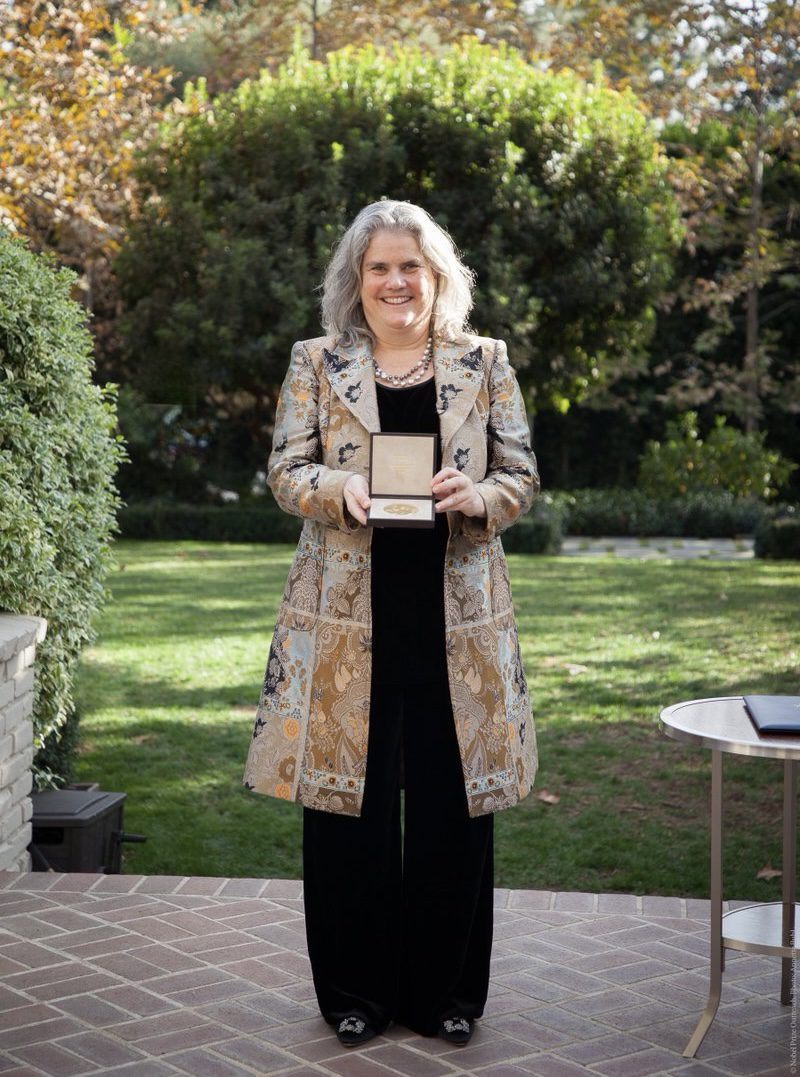
In 2020, she won the Nobel Prize for the discovery of a supermassive compact object at the center of the Milky Way galaxy. Since 1990, the scientist had been studying the object at the Milky Way’s center, called Sagittarius A, which turned out to be a supermassive black hole. She discovered an extremely heavy, invisible object, about four million times the mass of the Sun, all packed together in an area no larger than our solar system. Using the world’s largest telescopes, she developed methods to see through the vast clouds of interstellar gas and dust to the Milky Way’s center. This pioneering work provided compelling evidence for the existence of a supermassive black hole at the core of our galaxy.
Andrea Ghez is a pivotal figure in astronomy whose scientific achievements have had, and continue to have, a profound impact on space exploration. Her work elevates our understanding of the processes occurring in the depths of the Universe and helps solve some of astronomy’s greatest riddles.